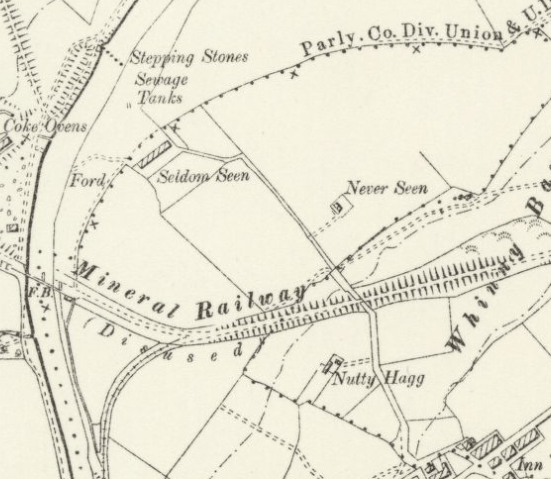
William Gomersall died at Seldom Seen on 10th November 1893. Earlier that day he had sprained himself while at work at Newfield Colliery, he returned home from work and began spitting blood and died a few hours later. William was my great great great grandfather.
William was born in 1831 in Liversedge in West Yorkshire, and in the 1850s came to County Durham with his young family. After working as a miner in Durham and Tudhoe, he returned to his home town in Yorkshire. I lost track of him for a while. Then I discovered when Eliza, his wife, died, he came back to County Durham to live with James, his son, my great great grandfather. It was at James’ home that he was to die.
Family history can be like putting together a jigsaw of people, dates and places. I like to visit the places where ancestors lived, so today I set off for Seldom Seen. County Durham has many unusual place names – including Billy Row, Pity Me, Quebec … and Seldom Seen. The problem is Seldom Seen doesn’t appear on a map today. I realised it must be near Newfield, now a former pit community near Bishop Auckland, as William worked at Newfield Colliery. So I searched larger scale old Ordnance Survey maps and found what I was looking for on the 6 inch 1895 Ordnance Survey map. A row of about eight houses in the bend of the River Wear between Newfield and Willington. I decided to go and see.
So began an adventure. What was a blank on a current map turned out to be a large inhospitable marshland, well overgrown. I took the path from Newfield to Willington, passing the remains of ‘Nutty Hag’ farm, and paused to look for ‘Never Seen’ farm remains, but they were not to be seen. After some searching I finally came across the remains of Seldom Scene, hidden and overgrown by hawthorn bushes and brambles. From his work among, at the time 600 men and boys, William and James must have returned to this quiet hidden place each day.
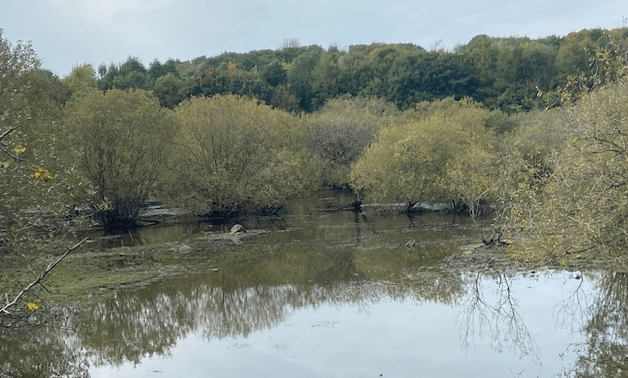
As I looked and walked in the area I was surprised. While the ground was inhospitable it unexpectedly opened out into a lovely view across the River Wear, and nearby small lakes, presumably water filled quarry areas, gave the area a hidden, mysterious feel.
What a difficult, and curious, life many of the miners lived. Crushed and dirty work down the pit (William was a hewer), and homes, often kept spotlessly clean, and sometimes in remote and beautiful settings.
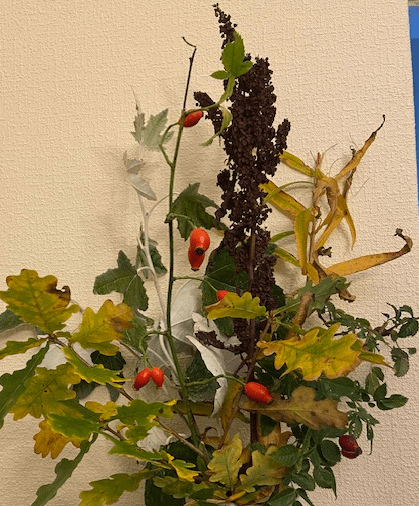
As I explored the area I collected some branches for an Autumn display. As I looked at them I speculated that perhaps William had looked on the plant ancestors of these branches, and I wondered if he did if he mused about the world his descendants would occupy.
 A Retired Rector's Reflections
Leave a comment