At the beginning of the twentieth century the prominent north eastern ironmaking and mining company, Bolckow and Vaughan, re-excavated the closed Dean and Chapter Colliery at Ferryhill, County Durham, and re-opened it in 1904. At the same time they set about building over 800 houses for their workers, to the design of an untrained architect – their company accountant. The result is fascinating and has been described as ‘a remarkable complete model village, the best example in County Durham of a paternalistic attempt to provide superior community for miners.’
The village, Dean Bank, lies on the west side of Ferryhill. I recently visited, on a ‘family history visit’ to see where my great grandfather, Isaac Cockayne and his wife Elizabeth O’Mara and their family once lived.
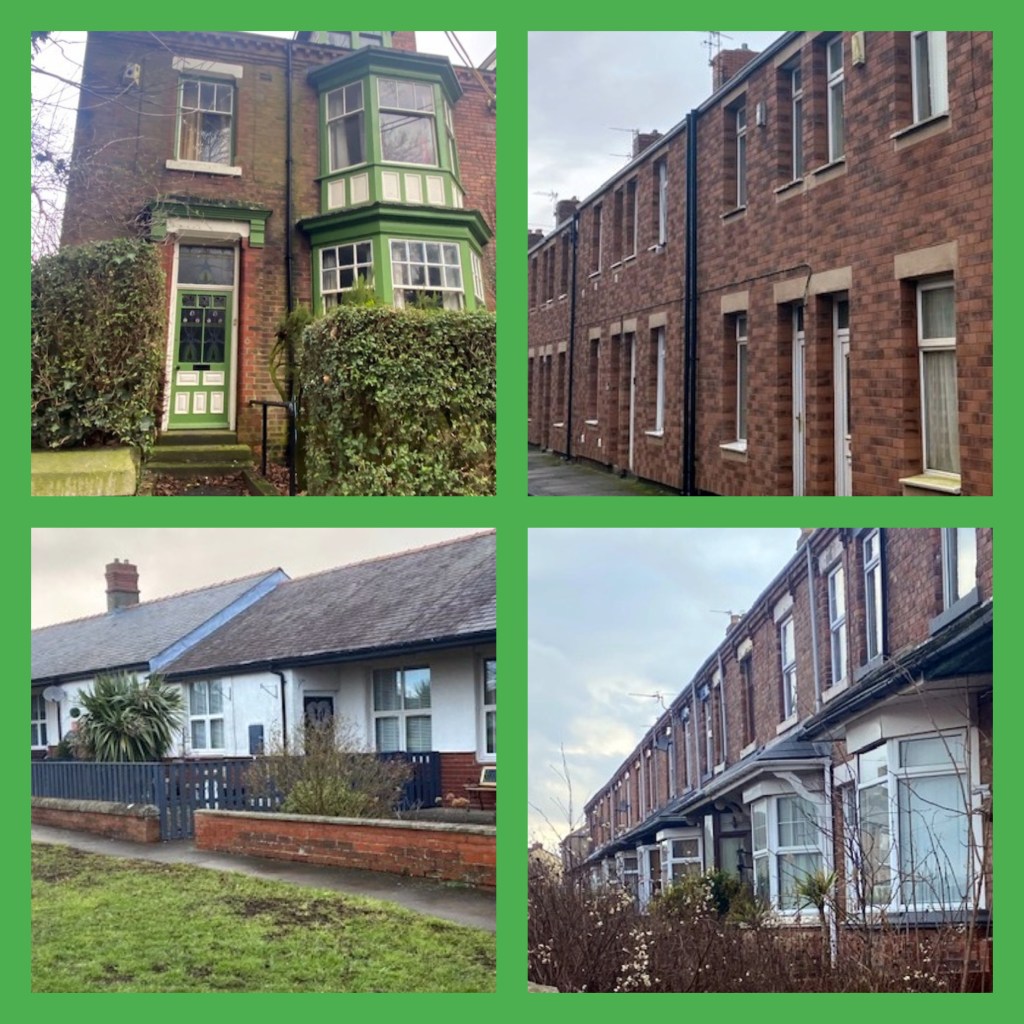
Dean Bank is a grid of streets but with subtelties reflecting the social hierachy of a mining community. A large detached house (now a nursing home) stands on the edge of the community. It was the Colliery Manager’s home. Nearby were a few houses, three storied with bay windows, for colliery deputies. Then senior officials had double bay windowed houses, and shift foremen single bays with garden in front. The miners themselves had terraced houses without bays or gardens, although some allotments were available nearby. At the western edge the heirarchy was completed by a row of ‘aged miners’ homes.’

There are some interesting extra features, such as the knocky up slates at some doors allowing the miner to indicate the time of his early mining shift. The school is a lovely feature, complete with Art Nouveau lettering.
The streets of Dean Bank were named after famous scientists or engineers whose work had some connection with mining – such as Newcomen, Davy, Faraday and Bessamer. In addition three Bishops of Durham who had a particular concern for miners are commemorated – Barrington, Lightfoot and Westcott.
No additional places of worship were provided, residents going to the churches or chapels of Ferryhill. The Cockaynes were staunch Catholics and strong supporters of All Saints RC Church, Dean Road, and indeed my grandparents, and parents, were all married there.

as it is today
My great grandparents, Isaac and Elizabeth, and their family were one of the first mining families to move into Dean Bank. They moved to 7, Hackworth Street, from nearby Tudhoe. They were in their early forties with a large family. Their neighbours in their street were from different parts of the country, some from local towns, Tow Law and Bishop Auckland for example, while others were from further afield, Northallerton, Derbyshire, Gloucestershire and County Mayo in Ireland. The relatively young families entered a newly forming community in which all householders had the same employer, and in which there was a clear heirarchy.
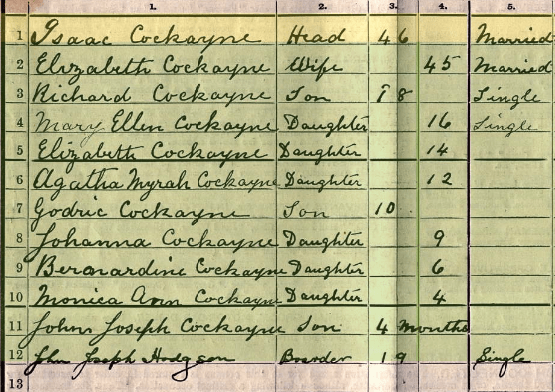
The Cockayne’s house in Hackworth Street was two bedroomed and yet the 1911 census tells us Isaac and Elizabeth were living there with nine children, the youngest being my grandfather who was at the time three months old. Surprisingly they also had a boarder living with them, a student mining surveyor, John Hodgson. In total twelve people living in a two bedroomed house.
The Cockaynes at number 7 were not unusual. Next door the Dixons had a family of eight, and at number 5 the Hodgsons had a family of eleven. Very different days from today in many ways. Work was very hard, not just for the miners and other pit workers, but undoubtedly also for their wives with such large families needing food and care.
Isaac and Elizabeth were to live at 7, Hackworth Street for over twenty years. Isaac then retired into Ferryhill. The colliery which at its height employed over 3,000 miners gradually decreased in fortune and closed in 1966. The Dean Bank houses were sold off and a different community formed in its streets.
 A Retired Rector's Reflections
Leave a comment