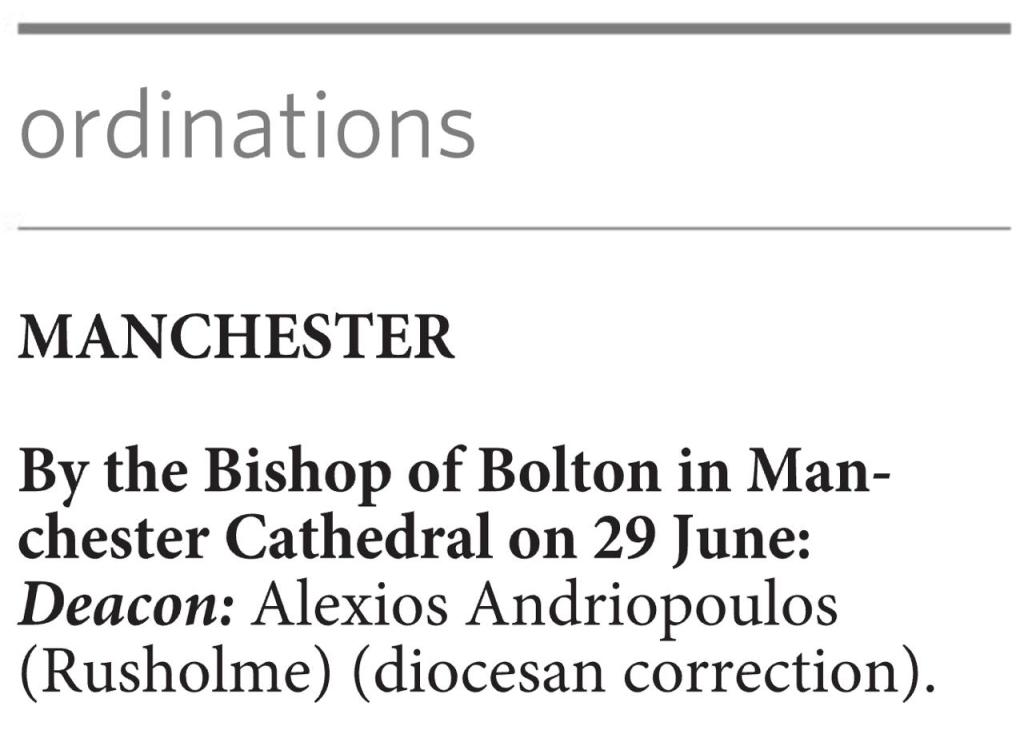
An interesting and, for the Church of England, very significant correction has appeared in the latest issue of the Church Times. A copy appears above. Those who attended the ordination of deacons at Manchester Cathedral (see this earlier blog post) were informed in the order of service that all candidates were being ordained deacon by the Bishop of Manchester. That the candidates were so ordained was stated afterwards on the diocesan website and in the press report. Now, one presumes because public questions have been asked, the diocese has come clean and admitted to the Church Times that this was not in fact true. One candidate at the ordination was ‘ordained’ by the Bishop of Bolton.
It is assumed, and this has not been refuted, that the candidate declined to be ordained by a bishop who supported gay blessings. To satisfy the candidate the bishops in Manchester diocese slipped in a fudge unprecedented in the Church of England. During the ordination prayer, said by the Bishop of Manchester, all candidates had hands laid on by the diocesan bishop and the short formula was said, except, that is, for one. For him the Bishop of Bolton said the words and laid hands.
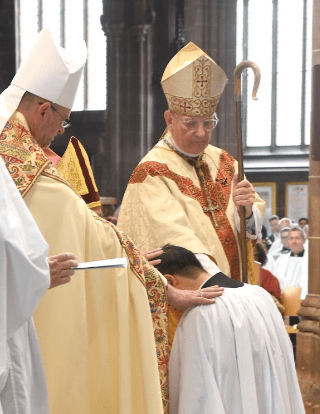
In fact there were two significant issues at this ordination. Firstly, contrary to the tradition of the church through the centuries not just one but several bishops laid on hands on the candidates for diaconal ordination (see photo). Anglican rules, and indeed the rules of other churches, do not permit this. So why are Manchester bishops doing it? What did the additional bishops think they were doing?
Secondly, by its published correction Manchester Diocese (and this surely must, in fact mean the bishops), are saying that very simply ordination does not require the complete ordination prayer. Manchester ‘diocese’ is saying ordination takes place by a bishop laying on hands and saying ‘Send down the Holy Spirit on your servant N. for the office and work of a deacon in your Church’ as quick, brief and simple as that. Again this is contrary to the historic tradition and theology of the church.
Not surprisingly several church theologians, including an Oxford theologian, have said they believe the ordination was very irregular and of dubious validity. Oh dear! At first these points may seem small. However, they symbolise something larger. They show a divided church with weak leadership where leaders will abandon the handed down tradition of the church for the sake of appeasement. However, by doing so they add to the division which already exists in the Church of England on contentious issues.
Whatever, in the face of church division over sexuality, Manchester bishops have undeniably set a precedent for ordinations. Presumably now, in Manchester diocese at least, inclusive minded candidates can request not to be ordained by the Bishop of Bolton.
So what would be preferable to this somewhat surreptitious and ill thought out action at Manchester Cathedral? Well, the candidate could have been ordained in a totally separate ordination, or, as has been done in past and present, the bishop of the diocese could have issued Letters Dimissory which authorise another anglican bishop to do the ordination for the bishop, at, for example, the candidate’s theological college. Or, perhaps, the diocesan bishop could have given clear leadership by affirming his authority and if the candidate declined to be ordained by him then the candidate could be given time to consider his position in the diocese.

 A Retired Rector's Reflections
Leave a comment