Thank you to my dear friend Fr Kenson Li, for providing this text of the sermon he gave at Manchester Cathedral on Sunday 18th January. Kenson ‘calls out’ the ‘grave injustice‘ and ‘baseless rejection’ by bishops of the Church of England of people in same sex marriages called to be priests.
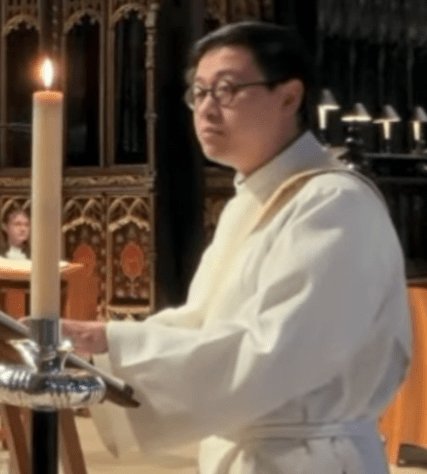
From the Gospel of today: It was about four o’clock in the afternoon.
In the Name of the Father, and of the Son, and of the Holy Spirit. Amen.
In all our readings today, there was a precise moment when the authors were called by God. Isaiah writes that he knew he was ‘called before he was born’, Paul speaks of being called to be an Apostle of Christ by the will of God, no doubt remembering his moment of conversion on the Road to Damascus, which we will celebrate next week; and in our Gospel reading, it was about four o’clock in the afternoon when John, the author of the Gospel, and Andrew knew that they must remain with Jesus.
In the life of any Christian, moments of realisation that they have been called by God are always memorable, because in these moments we realise our lives are part of something greater, and we are called to deeper fellowship with God and the people around us. Mine, for example, was on the night of Epiphany in 2019, when I struggled to fall asleep which was quite unusual for me. And I heard a voice from my heart: Kenson, you are called to be a priest. Having given it some thought, looked up what is the process of becoming a priest in the Church of England is and prayed about it, I slept peacefully that night. And here I am today. Preaching at Manchester Cathedral, on the Second Sunday of Epiphany in 2026, exactly seven years and twelve days after I first realised just what God is calling me to do in this life.
Christian vocation, that is, being called by God, goes beyond calling to ordained ministry. Indeed, the Church considers many things as God’s calling in our lives, that includes, for example, our baptism and confirmation, our work, our relationships, including friendships and marriage. They look different for each person because we are all different—not just different because of how we look, rather, it is different for us all because we are, each of us, a unique expression of God’s love. We are called into life, our living in this very present itself is a unique calling of God to live.
And so, the news we have received this last week, that the Church of England, will, for the foreseeable future, refuse to ordain men and women already married in same sex marriage, is something that I must call out as both a grave injustice and a baseless rejection of God’s call in the lives of LGBTQIA+ people.
For centuries, Christians of all sexualities, holy men and women, have served the Church throughout the world faithfully, and for many of them, the sacrifice of their identity and the loss of fruitful companionship were the price they had to pay to respond to God’s call in their lives. The Church must now recognise that this is no longer a justifiable sacrifice required of them, there simply is no theological reason for denying them ordination. If homosexual people are called to ordained ministry, they are called to ordained ministry, just like me; if they are called to faithful, loving, life-long companionship with a same-sex partner, the Church must recognise that the pattern of life they have been called to is none other than the institution of Holy Matrimony, of marriage, which is also a vocation I share. The only difference in this whole equation is that I am a heterosexual man, and they are not. Indeed, when I was writing this sermon, I had intended to say, if you follow God’s call in your life, you may end up where I am now, preaching at Manchester Cathedral on a Sunday morning, but I simply cannot say that, that simply is not true.
For far too long LGBTQIA+ people have had to choose between responding to God’s call to ministry, and God’s call to love through married life. Why should it be any different for me than for any of my homosexual friends who have also discerned a call to ordained ministry?
If the Church sees both Marriage and Ordained ministry as expressions of Christian vocation, how can it continue to deny people in following God’s call faithfully, which may, and sometimes, lead them to both marriage and ordained ministry?
In all these expressions of ministry and love, that is, the expressions of spiritual gifts in us, there does not exist a higher or nobler calling, for all we do, we do for the Glory of God and for the love of God’s people; what underpins all these very different vocations is the one Lord who calls us. We are always called into deeper fellowship with one another. And so, we cannot accept that our fellow Christians who identify as LGBTQIA+ must choose one calling over the other. That simply is not the Church’s teaching of Christian vocation.
We have heard how Isaiah knows that he had been called by God before he was born, how Paul was called on the way to Damascus, how John, Andrew and Peter were called at Four o’clock in the afternoon. These are sufficient testimonies to us that God’s call to us is not only irresistible, it always happens in God’s time—not a time that is convenient for us, when we can plan things and sort things out before coming back to God’s call—no, they always happen in God’s own time. By this we know our lives are sanctified—for God’s calling in our lives sanctifies our human time—it places us in the greater picture of Creation, that is, God’s timeless divine love for the world.
If God’s call comes to us at God’s own time, then we cannot accept that homosexual people who have already entered same-sex marriage do not get called by God to ordained ministry; and if God’s call to ministry comes to them after they have married a same sex partner, we cannot justify delaying, or worse, denying the truthfulness, and ultimately, the holiness of such Christian callings, because in doing so, we are denying the holiness of these people’s lives.
Isaiah, called to proclaim the Divine Word of God, said:
Thus says the Lord, the Redeemer of Israel and his Holy One,
to one deeply despised, abhorred by the nations, the slave of rulers,
‘Kings shall see and stand up, princes, and they shall prostrate themselves,
because of the Lord, who is faithful, the Holy One of Israel, who has chosen you.’
Need I say more?
May there be another 4 o’clock in the afternoon, when those who hold power in the Church realise their calling is still to remain with Jesus—and this remaining, like Andrew and Peter, and all Christian martyrs after them, means to suffer for God’s own flock. May they feel the pain of injustice, may this pain teach them the truth of God’s calling in all our lives. May they end this grave injustice done to LGBTQIA+ Christians in the name of unity, of sound doctrine, of tradition, but in reality, is nothing but kowtowing to homophobia, transphobia, and the powers of the world, for whom the Church is but another arena to exercise control over others’ lives.
May there be another 4 o’clock in the afternoon, when God’s calling to the Church breaks in once more—in the divine disruption, no, in the divine rebuke of our comfortable, well planned, human time, the Kingdom comes, and God’s will is done. Friends, pray earnestly for the advance of such a Kingdom, for such a Day of the Lord, when the Father, and the Son, and the Holy Spirit, reign supreme over all hearts, now, forever and ever, to the ages of ages. Amen.
 A Retired Rector's Reflections
Leave a comment