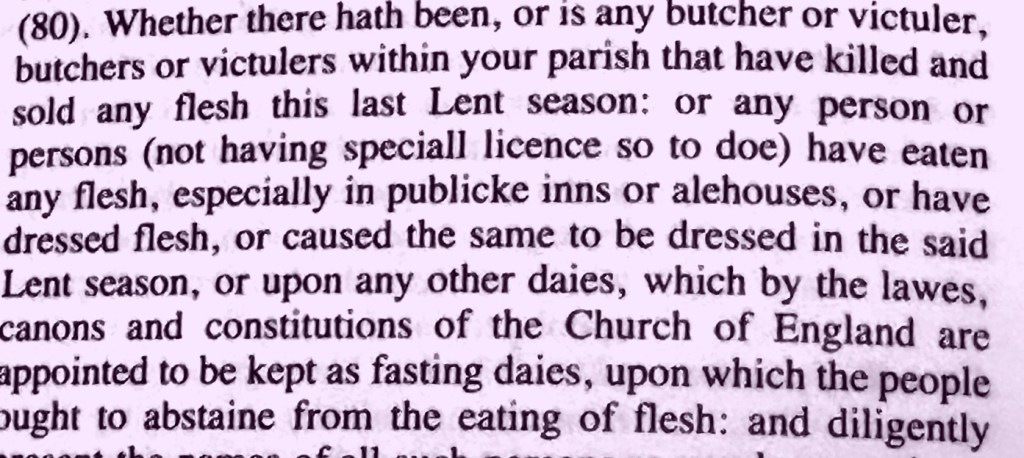
In 1609 Bishop James Montagu asked the churchwardens of his diocese of Bath and Wells to report to him the names who traded in meat, or who ate meat in Lent. (The visitation article is reproduced above.)
A bishop who asked this in 2026 would need to be prepared to receive an enormous list from the churchwardens of the diocese.
How we keep Lent has changed, not least in the Church of England. Its a rather diluted affair from what it was. I recently asked a churchgoer how he kept Lent and he replied by telling me that his church changed the altar frontal to the ‘Lenten array.’ Good for them, but that seemed to me a rather minimal, and ‘in house’, way of keeping the forty days. There are, surely, many different enriching ways of observing Lent, and fasting must be one of them.
Fasting is without doubt a spiritual discipline about which we all, myself included, would benefit from hearing more about, and receiving more encouragement. Of course people often say they will be doing without chocolate or bacon sandwiches or whatever in Lent. I am often surprised by how many none church goers observe the season in this way. It would be good to have it explained why this is of spiritual value and how it can be developed.
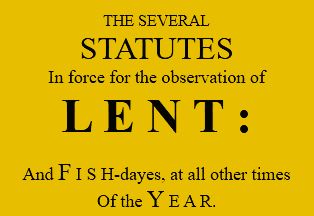
On 14th February 1660 Samuel Pepys noted in his diary that it was ‘the talk of the town… whether Lent shall be kept with the strictness of the King’s proclamation’ (the King had proclaimed no meat to be eaten in Lent). Pepys felt it would be difficult to follow the command, and indeed he noted he failed to do so two days into Lent.
I’ve planned a more rigorous Lent this year, and I aim for it to extend beyond devotional reading or special times of prayer, into areas of health, well being, fasting and giving. I’m sure like Mr Pepys I will slip a little early in Lent, but hopefully I will try, try, try again.
What will you be doing for Lent?
 A Retired Rector's Reflections
Leave a comment