Chrism Masses today are unusual and unsettling for me. What are they about?
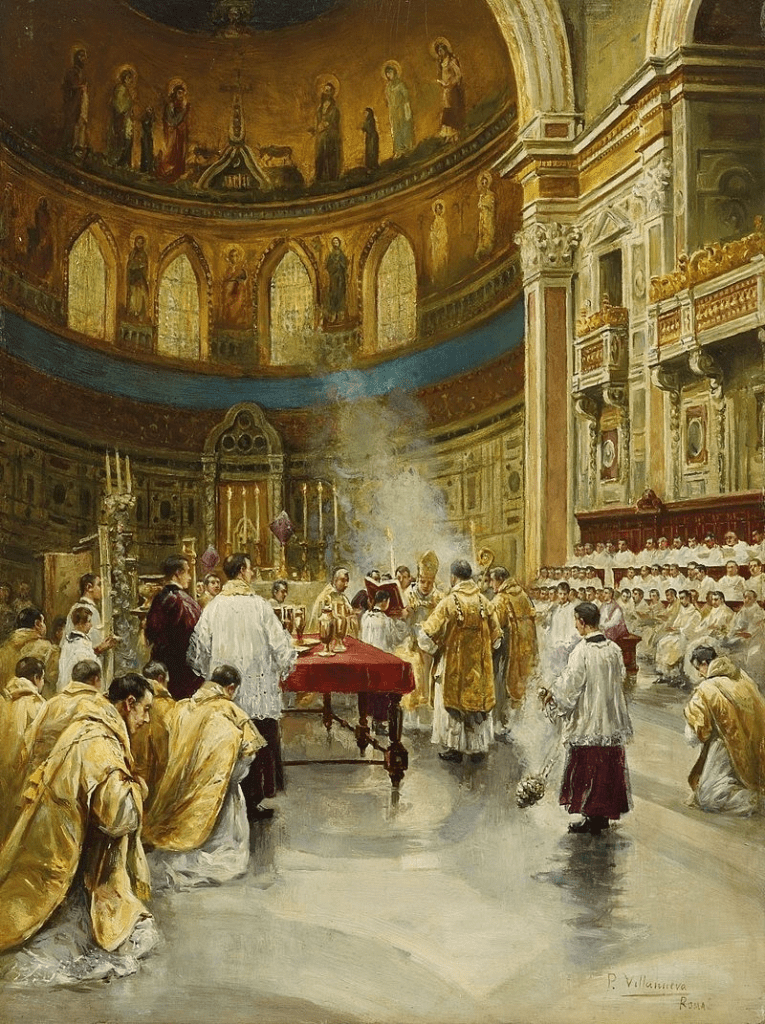
Until the 1950s and 60s the answer to that question would have been straightforward. The Chrism Mass is when the Bishop consecrates the sacred oil. In the older rite, found principally in the Roman Catholic Church, the bishop attended by twelve priests, seven deacons and seven subdeacons, all fully vested, consecrated the oil of chrism and also, usually, blessed the oil of healing and the oil of catechumens. The new oils were required for Eastertide, when baptisms principally took place. That Mass, according to Fr Henry Thurston SJ, “must be regarded … as perhaps the most imposing ritual of the Church.”
Times change, liturgy has been simplified, and new emphases develop. By the end of the 20th century, priests were also invited to renew their commitment to ministry at the Chrism Mass, presumably because the Mass was usually celebrated on Maundy Thursday, the day associated with Our Lord’s institution of the Mass and priesthood.
Many Anglicans have taken this further and all in some form of ministry may be invited to renew ministerial commitment. To the observer I believe this large gathering of clergy and ministers for renewal of ministry has become the central part of the Chrism Mass, the blessing of oils seems peripheral. Indeed one evangelical group in the Church of England has recently dispensed with the Chrism in favour of simply renewing ministerial commitment.
Photographs of recent Chrism masses often are of large groups of priests with bishops looking to the camera. Seldom is the sacred chrism or the act of its consecration photographed. Indeed sermons, often given by a bishop, talk primarily of ministry and commitment, with usually only a passing reference to the sacraments and the sacramental oils. And so we find, for example, the then Archbishop of Canterbury at the Chrism Mass at Canterbury Cathedral in 2022 making no reference whatsoever to the oils or anointing in his sermon. He spoke rather of the weight of ministry.
This year I received an invitation to attend a Chrism Mass, although the worship was referred to in that way the content of the invitation letter made no mention of oils, preferring to emphasise renewing ‘commitment to ministry.’
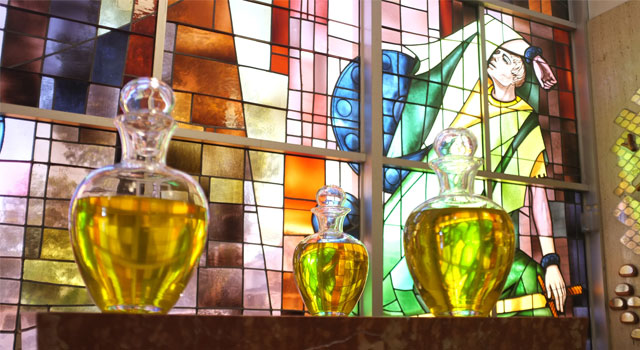
At the Chrism Mass bells ring out, the Gloria is sung and white vestments are worn, even though the Mass is celebrated in Lent. It is a Mass of joy. The Mass celebrates and blesses the sacramental oils, which themselves symbolise, focus and bring about strengthening, healing, joy and gladness in the church. In particular the Chrism oil with its special perfume points to the beautiful fragrance of grace, God’s love, and God given faith and life. And there is more. The same oil of Chrism, the old reference books remind us, ‘flows’ through the Church in the sacraments of baptism, confirmation and ordination, and also at a coronation, as well as at the consecration of churches, sacred vessels, altars, and altar stones.
The modern Roman Catholic rite of the Chrism Mass says:
through the sign of holy Chrism,
you dispense your life and love to the human family.
By anointing them with the Spirit,
you strengthen all who have been reborn in Baptism.
Through that anointing you transform them into the likeness of Christ your Son
and give them a share in his royal, priestly, and prophetic work.
And therefore, for myself, I believe the central and joyful focus of the Chrism Mass should be the life and love of God, God’s grace, generously poured out on all people, and of which the Sacred Chrism, placed centrally, is a sacramental sign. In the context of such a celebration and focus, but surely supplementary to it, priests may well wish to renew their commitment to having a share in the outpouring of God’s life and love.

 A Retired Rector's Reflections
Leave a reply to Tim Chesterton Cancel reply