I was recently tentatively asked if I would be willing to take a funeral. The discrete enquiry came from the husband of a man who lives hundred of miles from me. He had accompanied and lovingly cared for his husband through the months leading finally to his death.
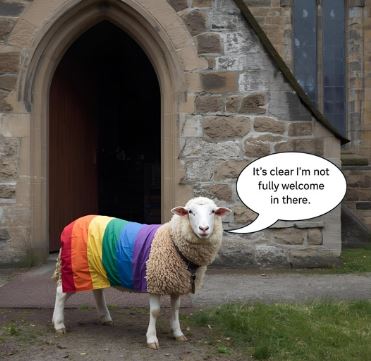
I was aware that the deceased man’s family had church connections so was anxious to be sure that for me to take the funeral was appropriate. I learned that, in fact, the local church had been approached. The member of the clergy responsible there had said they would be willing to take the funeral but would not be able to refer to the bereaved husband, or to the fact that the deceased person was married to a man. It was said this was because the Church does not approve of gay marriage and if he were to refer to the marriage in the funeral it would be seen as going against church teaching. This would be considered as a political act.
The bereaved husband, the chief mourner, of course had no wish to be ‘airbrushed’ out of his partner’s life at the funeral and so sought another venue and another person to conduct the funeral. Without hesitation I responded positively to the request. The funeral went ahead, it was a moving occasion with the bereaved husband helping organise and, of course, being chief mourner and several others taking part.
I was unpleasantly surprised and angered that this kind of ‘airbrushing’ could be suggested in today’s ‘all are welcome’ church. When I mentioned it to a priest friend he wasn’t so surprised. ‘Well the Church of England makes it very clear it is uncomfortable and suspicious about gay marriage,’ he said ‘so this sort of thing is bound to happen.’
I was reminded of words of the Bishop of Manchester, David Walker, who, commenting to his diocese on the commendation of prayers of blessing for gay couples by his fellow Church of England bishops said he, himself, would not use them. He went on to say “for me to do so would, in my view, abuse a pastoral provision by turning it into a political act.”
I wonder about a hypothetical situation. If a man died who had lived with a woman for many years without marriage, and they had had several children would the woman be ‘airbrushed’ out at the man’s funeral? After all their relationship would not be ‘approved’ by the church. Similarly Bishop Walker’s statement that he will not use the forms of prayer the bishops have agreed for blessing gay people is surely itself a ‘political’ position. To me this clearly shows an intrinsic bias against LGBT people within the Church of England.
When clergy, and bishops, decline ‘for political reasons’ to offer basic pastoral care to gay people at the most significant moments of their lives, and synods endlessly debate gay relationships, is it not surprising that so many LGBT people and their friends feel airbrushed out by the church, or rejected by it?


 A Retired Rector's Reflections
Leave a reply to The Rev’d Canon Sarah Jones Cancel reply